How to Choose Shade Fabric for Saudi Arabia’s Extreme Heat
Choosing the right shade fabric is one of the most important decisions when designing outdoor shade structures in Saudi Arabia. The country’s intense sunlight, high temperatures, strong UV exposure, dust, and occasional rain can place significant demands on outdoor fabrics.
The Best Shade Fabric for Saudi Arabia depends on several factors, including the location, structure type, required level of shade, waterproofing requirements, expected lifespan, maintenance needs, and project budget.
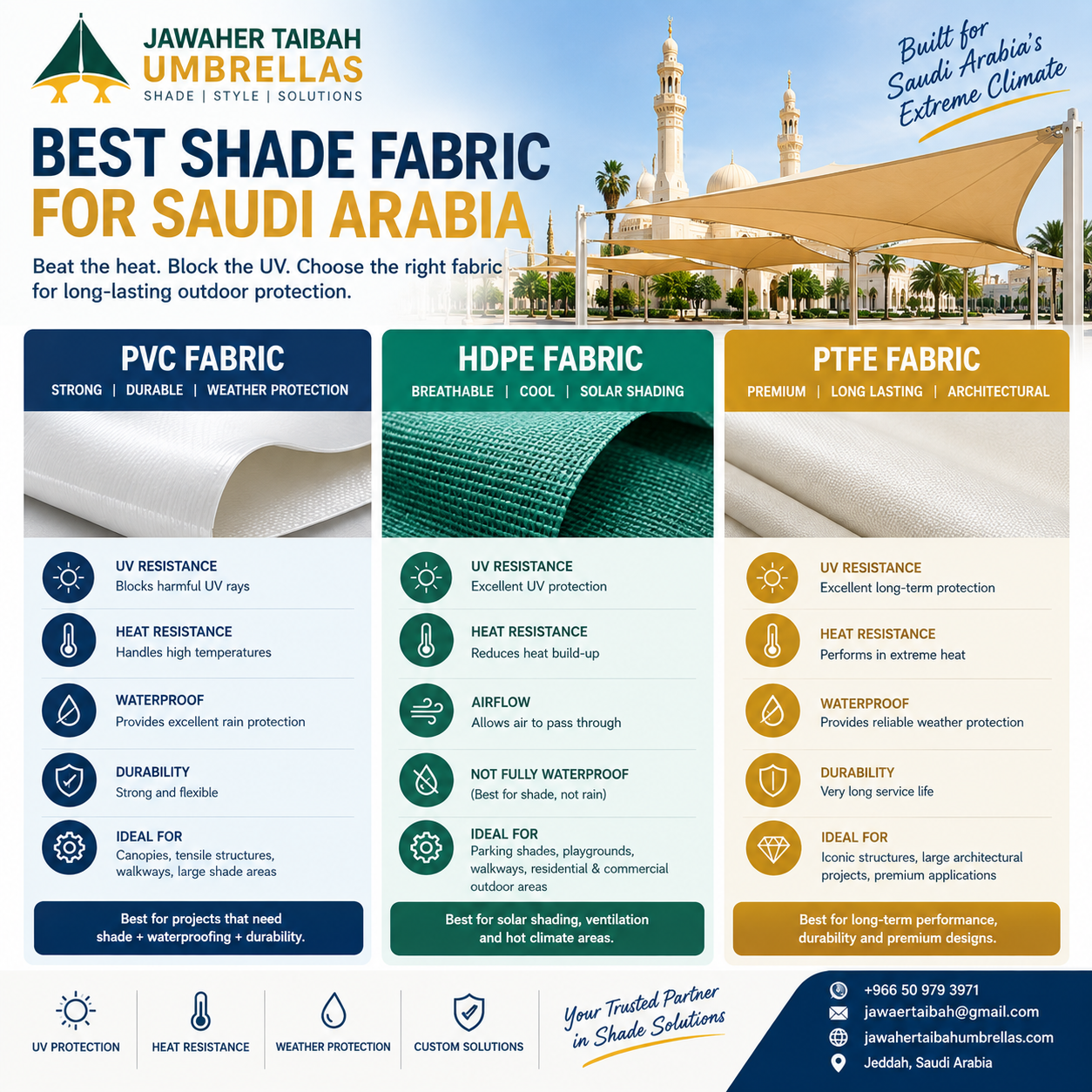
Common materials such as PVC fabric, HDPE fabric, and PTFE fabric each offer different advantages. Understanding their characteristics can help property owners, architects, contractors, and businesses select the most suitable Shade Fabric for Hot Climate applications.
Jawaher Taibah Umbrellas provides customized outdoor shade solutions for residential, commercial, industrial, and public projects in Jeddah and across Saudi Arabia.
Saudi Climate Challenges
Outdoor shade structures in Saudi Arabia must perform in demanding environmental conditions.
Extreme Heat
Summer temperatures can become extremely high, making heat resistance an important consideration when selecting outdoor materials.
Strong UV Exposure
Continuous exposure to intense sunlight can gradually affect fabric appearance and performance. A UV Resistant Shade Fabric is therefore important for long-term outdoor applications.
Dust and Sand
Dust and sand can accumulate on outdoor structures and increase cleaning requirements, particularly in open areas.
Occasional Rain
Although much of Saudi Arabia has a dry climate, outdoor structures can still experience rain and weather events. Projects requiring complete rain protection may need a Waterproof Fabric solution.
Coastal Conditions
In coastal cities such as Jeddah, humidity and salt exposure can also influence the selection of the complete shade system, including fabric, steel, aluminum, fasteners, and protective coatings.
What Makes a Good Shade Fabric?
A good Outdoor Shade Fabric should be selected according to the specific application rather than simply choosing the most expensive material.
Important characteristics include:
- High UV resistance
- Heat resistance
- Appropriate solar protection
- Weather resistance
- Tear and tensile strength
- Dimensional stability
- Suitable waterproofing
- Easy maintenance
- Long service life
- Compatibility with the structural design
The right balance of these characteristics determines whether a fabric is suitable for a parking shade, walkway, pergola, tensile structure, outdoor seating area, or large architectural canopy.
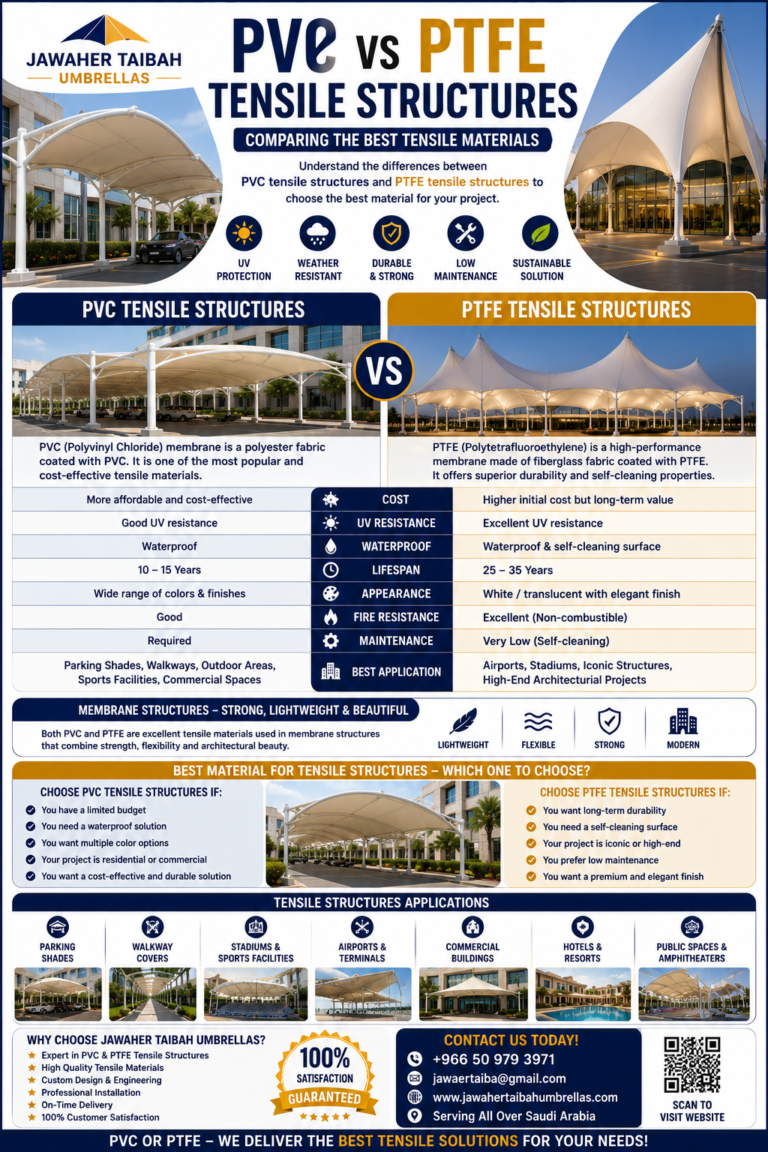
PVC Fabric
PVC-coated fabric is a popular option for applications where weather protection and durability are important.
PVC membranes are manufactured by coating a fabric base with PVC, creating a material suitable for larger shade and canopy structures.
Advantages of PVC Fabric
- Good weather resistance
- Available in waterproof configurations
- Suitable for large structures
- Strong and flexible
- Available in different colors and finishes
- Suitable for architectural applications
- Can provide both shade and rain protection
PVC is particularly useful where the project requires more than basic solar shading.
Common Applications
PVC fabric can be considered for:
- Tensile structures
- Large canopies
- Walkway covers
- Commercial shade structures
- Outdoor gathering areas
- Parking structures
- Restaurant and hospitality applications
HDPE Fabric
HDPE fabric is widely used for outdoor shade applications where the primary objective is solar protection and airflow.
HDPE shade cloth is designed to provide shade while allowing air to pass through the material. This can be beneficial in hot outdoor environments.
Advantages of HDPE Fabric
- Excellent outdoor shading capability
- Good UV resistance
- Lightweight
- Allows airflow
- Suitable for hot climates
- Available in different shade percentages
- Flexible design possibilities
- Generally easy to maintain
HDPE can be a practical choice for parking areas, playgrounds, recreational spaces, walkways, schools, and residential applications.
Important Consideration
HDPE shade fabric is generally selected primarily for solar shading, rather than complete waterproofing. If rain protection is a major requirement, a waterproof membrane or solid roofing solution may be more appropriate.
PTFE Fabric
PTFE-coated fiberglass fabric is a high-performance architectural membrane used for demanding and long-term structures.
It is often selected for major architectural projects where durability, dimensional stability, and long service life are priorities.
Advantages of PTFE Fabric
- Excellent durability
- High resistance to UV exposure
- Strong weather resistance
- Excellent dimensional stability
- Suitable for large architectural structures
- Long potential service life
- Low maintenance requirements
PTFE can be appropriate for major architectural tensile structures where the initial investment is justified by the expected performance and longevity.
Fabric Comparison Table
| Feature | PVC Fabric | HDPE Fabric | PTFE Fabric |
|---|---|---|---|
| UV Resistance | High | High | Excellent |
| Heat Performance | High | High | Excellent |
| Waterproofing | Excellent with suitable membrane | Generally limited | Excellent |
| Airflow | Limited | Excellent | Limited |
| Durability | High | High | Excellent |
| Typical Lifespan | Project dependent | Project dependent | Generally very long |
| Maintenance | Moderate | Low to moderate | Low |
| Typical Cost | Medium | Lower to medium | Higher |
| Best For | Canopies & tensile structures | Solar shade | Premium architectural structures |
Actual performance and lifespan depend on fabric specification, installation quality, structural design, environmental exposure, and maintenance.
UV Performance
UV resistance is one of the most important characteristics when selecting a UV Resistant Shade Fabric for Saudi Arabia.
Continuous exposure to sunlight can cause gradual deterioration of unsuitable materials. High-quality outdoor fabrics are designed to withstand prolonged UV exposure while maintaining their structural and visual performance.
For Saudi projects, consider:
- Fabric UV rating
- Coating quality
- Color stability
- Manufacturer specifications
- Expected exposure level
- Installation orientation
The fabric should always be selected according to the expected environmental conditions and application.
Heat Performance
A Heat Resistant Shade Fabric helps create more comfortable outdoor environments by reducing direct solar exposure.
However, fabric performance should not be judged only by how hot the material itself becomes. The overall design also matters.
Heat performance can be influenced by:
- Fabric color
- Fabric construction
- Shade percentage
- Solar reflectance
- Ventilation
- Structure height
- Orientation
- Air circulation
HDPE can be especially useful where airflow is important, while membrane systems such as PVC and PTFE can provide more controlled architectural coverage.
Waterproofing
Not every shade fabric is designed to provide complete waterproof protection.
If the structure must protect people or equipment from rain, select a fabric system specifically designed for waterproof applications.
Waterproof options may include:
- PVC membrane systems
- Waterproof tensile fabrics
- PTFE membrane systems
- Metal roofing
- Other engineered roofing solutions
HDPE is generally better suited to solar shading and ventilation rather than complete waterproof coverage.
Therefore, the choice between a breathable shade fabric and a waterproof membrane should be based on the project’s actual requirements.
Lifespan
Fabric lifespan varies considerably depending on the material and environmental conditions.
Factors affecting lifespan include:
- UV exposure
- Heat
- Wind
- Dust
- Humidity
- Fabric quality
- Structural tension
- Installation quality
- Cleaning and maintenance
PTFE systems are generally associated with long-term architectural applications, while PVC and HDPE can provide durable performance when correctly specified and maintained.
Instead of selecting a fabric based only on its advertised lifespan, consider the total lifecycle cost, including installation, cleaning, repairs, and eventual replacement.
Maintenance
Regular maintenance helps extend the useful life of an outdoor shade structure.
Recommended maintenance may include:
- Removing accumulated dust
- Cleaning fabric according to manufacturer recommendations
- Inspecting seams and edges
- Checking tensioning systems
- Inspecting steel or aluminum frames
- Checking bolts and connection points
- Looking for tears or damage
- Checking drainage where applicable
- Repairing small problems before they become major issues
Coastal environments such as Jeddah may require additional attention to structural components because of humidity and salt exposure.
Which Fabric Should You Choose?
There is no single fabric that is automatically the Best Shade Fabric for Saudi Arabia for every project.
Choose HDPE when:
You primarily need solar shading, ventilation, and comfortable outdoor areas.
Suitable for: parking areas, playgrounds, recreational areas, schools, walkways, and residential spaces.
Choose PVC when:
You need a combination of shade, weather protection, waterproofing, and architectural flexibility.
Suitable for: tensile structures, commercial canopies, walkways, restaurants, outdoor gathering areas, and large shade structures.
Choose PTFE when:
Long-term performance, premium architectural appearance, and high durability are major priorities.
Suitable for: landmark projects, major public facilities, large architectural tensile structures, and premium developments.
Ultimately, the best material should be selected according to the project’s location, structure, design, environmental exposure, waterproofing requirements, expected lifespan, and budget.
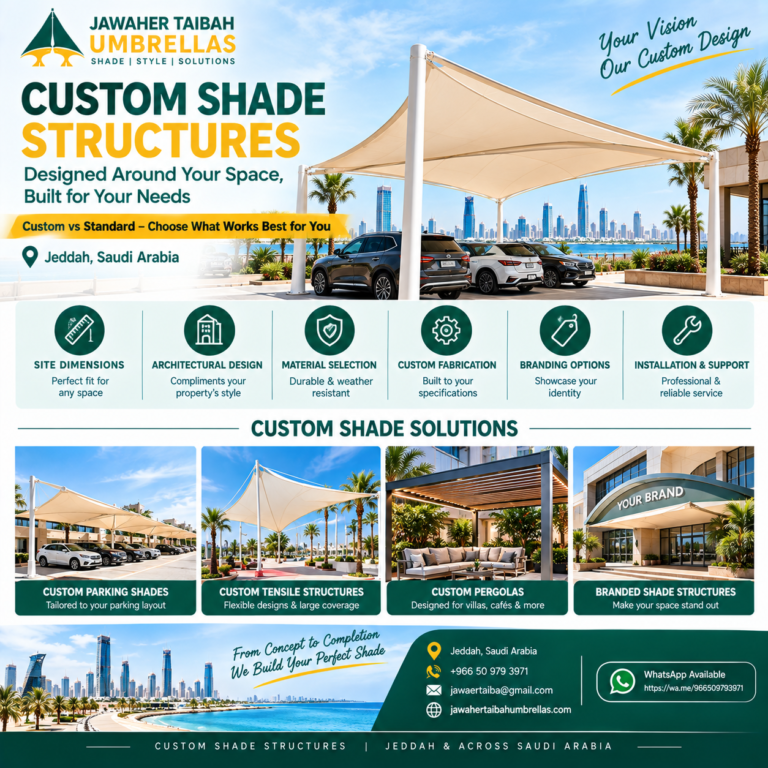
Customized Shade Fabric Solutions in Saudi Arabia
Every outdoor project has different requirements. A professional shade manufacturer can help evaluate the site and recommend an appropriate combination of fabric and structural system.
Jawaher Taibah Umbrellas provides customized shade solutions in Jeddah and across Saudi Arabia, including:
- HDPE shade structures
- PVC membrane structures
- Tensile shade systems
- Parking shades
- Walkway shades
- Pergolas
- Outdoor canopies
- Custom shade structures
Services include design, manufacturing, installation, maintenance, repair, refurbishment, and customized fabrication.
FAQs
1. What is the best shade fabric for Saudi Arabia?
The best fabric depends on the application. HDPE is suitable for breathable solar shading, PVC is useful for waterproof and architectural applications, while PTFE is suited to premium long-term architectural structures.
2. Is HDPE suitable for Saudi Arabia’s heat?
Yes. HDPE can be a practical option for hot outdoor environments because it provides solar shading while allowing airflow.
3. Is PVC fabric waterproof?
Suitable PVC membrane systems can provide excellent waterproofing when properly designed, manufactured, and installed.
4. Is PTFE better than PVC?
Not necessarily. PTFE generally offers higher long-term performance and durability, but PVC may be more appropriate where project requirements and budget favor it.
5. Which shade fabric provides the best UV resistance?
PTFE generally offers excellent UV resistance, while high-quality PVC and HDPE fabrics can also provide strong UV performance when properly specified.
6. Can shade fabric reduce outdoor heat?
Shade fabric reduces direct solar radiation and can make shaded areas significantly more comfortable. Actual temperature reduction depends on fabric properties, structure design, ventilation, orientation, and surrounding conditions.
7. Is HDPE fabric waterproof?
HDPE shade cloth is generally designed primarily for solar shading and airflow rather than complete waterproofing. Waterproof applications normally require a suitable membrane or roofing system.
8. How long does outdoor shade fabric last?
Lifespan varies according to fabric type, quality, UV exposure, weather, installation, and maintenance. The manufacturer’s technical specifications should be reviewed for each project.
9. Can shade fabric be customized?
Yes. Shade structures can be customized in size, shape, color, fabric type, structural design, and coverage according to the project requirements.
10. Do you provide shade fabric solutions in Jeddah?
Yes. Jawaher Taibah Umbrellas provides customized shade structures and fabric solutions for residential, commercial, industrial, and public projects in Jeddah and across Saudi Arabia.
Conclusion
Selecting the right Shade Fabric for Hot Climate applications requires more than simply choosing a material based on price. Saudi Arabia’s extreme heat, strong UV exposure, dust, and weather conditions make fabric quality and structural design particularly important.
HDPE, PVC, and PTFE fabric each have different strengths. HDPE is well suited to breathable solar shading, PVC offers a versatile combination of shading and waterproofing, and PTFE provides premium long-term performance for demanding architectural projects.
For the Best Shade Fabric for Saudi Arabia, evaluate the project’s application, climate exposure, waterproofing requirements, expected lifespan, maintenance needs, and budget before making a final decision.
Contact Jawaher Taibah Umbrellas
Jawaher Taibah Umbrellas
📍 Jeddah, Saudi Arabia
📞 +966 50 979 3971
📧 jawaertaiba@gmail.com
🌐 jawahertaibahumbrellas.com
Contact us for customized HDPE, PVC, PTFE, tensile shade structures, parking shades, walkway covers, pergolas, and outdoor shade solutions in Jeddah and across Saudi Arabia.