Pergola vs Tensile Structure: Which Is Better for Outdoor Spaces?
When planning an outdoor shade area in Jeddah, one of the most common questions is whether to choose a Pergola vs Tensile Structure. Both options can provide effective shade, improve outdoor comfort, and enhance the appearance of residential and commercial properties, but they work in different ways.
A pergola typically uses a rigid frame made from aluminum, steel, or other structural materials, while a Tensile Shade Structure uses a tensioned membrane supported by a structural framework.
The right option depends on the project’s purpose, available space, design preferences, required heat protection, waterproofing, maintenance expectations, installation requirements, and budget.
This Pergola Comparison explains the main differences to help property owners, architects, contractors, and businesses choose an appropriate outdoor shading solution for Jeddah’s climate.
What Is a Pergola?
A pergola is a permanent outdoor structure consisting of a supporting frame and a roof system. Modern pergolas can be manufactured from aluminum, steel, wood, or combinations of different materials.
Depending on the design, a pergola may include:
- Fixed louvers
- Adjustable louvers
- Retractable fabric
- Polycarbonate or other roofing
- Glass elements
- Side screens
- Waterproof roofing systems
Pergolas are commonly installed over patios, terraces, gardens, pool areas, restaurants, cafés, villa outdoor spaces, and commercial seating areas.
For Jeddah properties, aluminum pergolas and properly protected steel pergolas are popular options because they can be customized to suit contemporary architectural designs.
What Is a Tensile Structure?
A tensile structure uses a flexible membrane that is stretched and tensioned over a structural framework.
The membrane can be supported by:
- Steel columns
- Arches
- Cables
- Masts
- Beams
- Specialized connection systems
Tensile structures can cover large areas while creating lightweight architectural forms. They are commonly used for parking areas, walkways, entrances, playgrounds, schools, commercial properties, sports facilities, public spaces, and large outdoor gathering areas.
A well-designed Tensile Shade Structure can provide extensive solar protection while maintaining an open and visually lightweight appearance.
Design Comparison
Design is one of the biggest differences between a pergola and tensile structure.
Pergola Design
Pergolas generally have a more architectural, solid, and structured appearance. Their straight lines and rigid framework can complement modern villas, hotels, restaurants, cafés, and commercial buildings.
They can also incorporate adjustable elements, allowing users to control sunlight and ventilation.
Tensile Structure Design
Tensile structures provide greater freedom for curved, flowing, and sculptural forms.
Membranes can be shaped into:
- Conical forms
- Sail shapes
- Hypar structures
- Curved canopies
- Wave-like designs
- Custom architectural forms
For large outdoor areas, tensile structures can create broad shade coverage without making the space look heavily enclosed.
Design Difference at a Glance
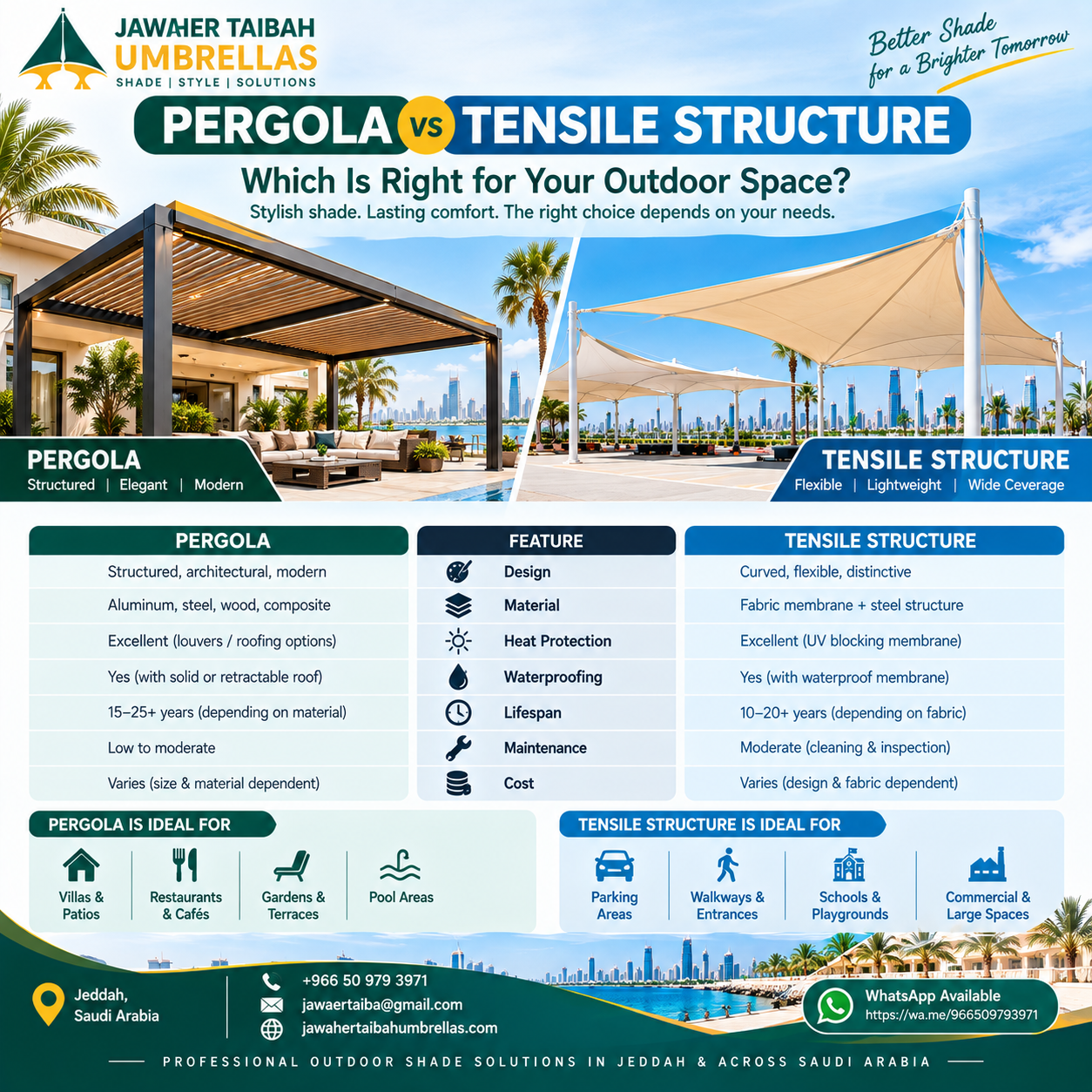
| Feature | Pergola | Tensile Structure |
|---|---|---|
| Appearance | Architectural and structured | Lightweight and sculptural |
| Shape | Mostly straight/rigid | Curved and flexible |
| Customization | High | Very high |
| Large-area coverage | Suitable | Excellent |
| Modern architectural designs | Excellent | Excellent |
Material Comparison
Material selection directly affects durability, appearance, maintenance, and cost.
Pergola Materials
Common pergola materials include:
Aluminum: Lightweight, corrosion-resistant, and suitable for modern outdoor applications.
Steel: Strong and suitable for larger or heavier structures when properly galvanized or coated.
Wood: Offers a natural appearance but generally requires more maintenance in demanding outdoor environments.
Tensile Structure Materials
Tensile structures commonly use engineered membrane fabrics such as:
- PVC-coated polyester
- HDPE
- PTFE-coated fiberglass
- Other specialized architectural fabrics
The supporting structure is typically made from steel or other engineered materials.
For Jeddah, material selection should account for intense UV exposure, heat, humidity, dust, wind, and coastal conditions.
Heat Protection
Heat protection is an important consideration when comparing a Pergola or Tensile Structure in Saudi Arabia.
Both can reduce direct solar exposure, but performance depends on the roof design, material, color, coverage, ventilation, and orientation.
Pergola Heat Protection
Pergolas can provide effective shade using:
- Louvers
- Solid roofing
- Fabric covers
- Retractable systems
- Adjustable roof systems
Open-louvered pergolas can combine shade with natural air circulation.
Tensile Structure Heat Protection
Tensile membranes can provide extensive overhead coverage and block direct sunlight across large areas.
The fabric specification can influence:
- UV protection
- Solar reflectivity
- Light transmission
- Thermal performance
- Durability
For parking areas and large outdoor spaces, a properly designed tensile membrane can provide broad shade coverage while maintaining open sides for ventilation.
Waterproofing
Waterproofing requirements can influence the choice between these two systems.
A pergola can be designed with waterproof roofing or specialized retractable systems, depending on the product.
Tensile structures can also provide waterproof protection when a suitable waterproof membrane is selected and the structure is correctly designed for drainage and membrane tension.
However, not every shade fabric is waterproof.
For example, some breathable shade fabrics are designed primarily for solar protection rather than complete rain protection.
Therefore, if rain protection is a major requirement, the material specification should be confirmed before installation.
Lifespan
The lifespan of either structure depends on material quality, structural engineering, installation, environmental exposure, and maintenance.
Pergola Lifespan
A properly designed aluminum pergola can potentially provide 15–25 years or more with appropriate maintenance.
Protected steel pergolas can also provide long service lives when corrosion is properly controlled.
Tensile Structure Lifespan
Quality tensile membrane systems can commonly provide approximately 10–20 years or more, depending on the fabric specification and environmental exposure.
Premium architectural membranes can offer longer service lives in appropriate applications.
The supporting steel framework may remain serviceable considerably longer than the membrane when it is properly protected and maintained.
Maintenance
Both systems require maintenance, although the type of maintenance differs.
Pergola Maintenance
Typical pergola maintenance includes:
- Cleaning the roof
- Removing dust and sand
- Checking louvers
- Inspecting fasteners
- Checking drainage
- Inspecting protective coatings
- Controlling corrosion
- Maintaining moving components
Aluminum generally requires less corrosion-related maintenance than conventional unprotected steel.
Tensile Structure Maintenance
Tensile structure maintenance may include:
- Membrane cleaning
- Fabric inspection
- Seam inspection
- Checking tension
- Inspecting cables and connections
- Steel inspection
- Corrosion prevention
- Drainage checks
Regular inspections can help identify small problems before they develop into major repairs.
Cost
There is no universal price difference between a pergola and tensile structure because project costs depend on design and specification.
Important cost factors include:
- Structure size
- Material quality
- Fabric specification
- Steel or aluminum requirements
- Roof system
- Foundation requirements
- Engineering
- Customization
- Installation
- Site accessibility
- Waterproofing requirements
- Additional accessories
A simple pergola may be more economical for a small residential patio, while a tensile structure can be practical for covering a large parking area or walkway.
For an accurate comparison, both systems should be designed according to the same project requirements before comparing quotations.
Best Applications
The best Outdoor Shade Comparison depends heavily on how the space will be used.
Pergolas Are Suitable For:
- Residential villas
- Patios
- Gardens
- Rooftops
- Terraces
- Poolside areas
- Restaurants
- Cafés
- Hotel outdoor areas
- Luxury outdoor living spaces
Pergolas are particularly suitable when architectural appearance and integration with the building are important.
Tensile Structures Are Suitable For:
- Car parking
- Large walkways
- School playgrounds
- Sports facilities
- Commercial entrances
- Public spaces
- Outdoor gathering areas
- Large parking facilities
- Industrial sites
- Institutional projects
Tensile structures are especially useful where extensive coverage and distinctive architectural forms are required.
Pergola or Tensile Structure: Which Should You Choose?
Instead of asking which one is universally better, consider what your project actually requires.
Choose a pergola when you prioritize:
- Architectural integration
- Premium outdoor appearance
- Rigid structural design
- Adjustable louvers
- Residential patios and terraces
- Restaurants and cafés
- Outdoor living spaces
Consider a tensile structure when you need:
- Large-area shade coverage
- Lightweight architectural forms
- Curved or custom designs
- Parking protection
- Walkway coverage
- Playground or public-space shading
- Extensive UV protection
Both systems can be excellent outdoor shading solutions when correctly designed and installed.
Best Outdoor Shade Structure for Jeddah
Jeddah’s coastal climate presents several challenges for outdoor structures, including strong sunlight, UV exposure, high temperatures, humidity, dust, sand, and salt air.
For this reason, the Best Outdoor Shade Structure should be selected based on the specific application rather than choosing a structure simply because it is more popular or visually attractive.
For example:
- A villa terrace may benefit from a customized aluminum pergola.
- A restaurant may require a pergola with adjustable or waterproof roofing.
- A commercial parking facility may benefit from a tensile parking shade.
- A pedestrian walkway may require a continuous tensile canopy.
- A large public area may benefit from a custom tensile structure.
Professional site assessment can help determine the appropriate combination of materials, structure type, coverage, ventilation, and foundation requirements.
Final Recommendation
Both pergolas and tensile structures have distinct advantages.
A pergola can be a strong choice for residential and hospitality spaces where architectural integration, structured design, and outdoor living are important.
A tensile structure can be well suited to large-area shading, parking, walkways, entrances, playgrounds, and projects requiring lightweight or sculptural architectural forms.
The final selection should consider cost, durability, design, maintenance, heat protection, waterproofing, installation, material quality, and the specific requirements of the site.
For properties in Jeddah, it is also important to consider UV exposure, humidity, salt air, dust, wind, and long-term corrosion protection during the design stage.
FAQs
What is the difference between a pergola and a tensile structure?
A pergola generally uses a rigid roof or louvered frame, while a tensile structure uses a tensioned flexible membrane supported by a structural framework.
Is a pergola better than a tensile structure?
Neither is universally better. The appropriate choice depends on the project’s size, design, use, budget, waterproofing needs, heat protection requirements, and desired appearance.
Which provides better heat protection?
Both can provide effective solar protection. Performance depends on the material, coverage, color, roof design, orientation, and ventilation. A properly specified tensile membrane can provide extensive coverage, while a pergola can combine shade with adjustable louvers or other roofing systems.
Which is more durable, a pergola or tensile structure?
Durability depends on the materials and environmental exposure. A properly protected aluminum or steel pergola can have a long service life, while quality tensile membranes can also provide many years of outdoor performance.
Which requires less maintenance?
Maintenance depends on the specific system. Aluminum pergolas generally have relatively low corrosion-maintenance requirements, while tensile structures require periodic membrane cleaning and inspection in addition to structural checks.
Are tensile structures waterproof?
Some tensile membranes are waterproof, while others are designed primarily for solar shading. The fabric specification and structural design should be selected according to the project’s waterproofing requirements.
Are pergolas suitable for Jeddah’s climate?
Yes. Properly designed pergolas can provide effective shade for villas, restaurants, cafés, hotels, terraces, and commercial outdoor spaces. Material selection and corrosion protection are important in Jeddah’s coastal environment.
Are tensile structures suitable for Saudi Arabia?
Yes. Tensile structures are widely suitable for applications requiring large outdoor shade coverage. Their design should account for local heat, UV exposure, wind, dust, humidity, and other environmental conditions.
Professional Pergola & Tensile Shade Solutions in Jeddah
Jawaher Taibah Umbrellas provides customized pergolas and tensile shade structures in Jeddah, Saudi Arabia, for residential, commercial, industrial, institutional, and public projects.
Our solutions include:
- Custom Pergolas
- Aluminum Pergolas
- Tensile Shade Structures
- Parking Shades
- Walkway Canopies
- Entrance Canopies
- Outdoor Shade Structures
- Custom Canopies
We can help evaluate your project requirements and develop a shade solution based on design, durability, heat protection, material quality, installation, and long-term maintenance.
📍 Jeddah, Saudi Arabia
📞 +966 50 979 3971
📧 jawaertaiba@gmail.com
🌐 jawahertaibahumbrellas.com
💬 WhatsApp: https://wa.me/966509793971
Jawaher Taibah Umbrellas — Professional Outdoor Shade Solutions in Jeddah & Across Saudi Arabia.